


Page 29 - My FlipBook
P. 29
light on significant milestones
            and transformative changes.

            Introducing                Zhonghua
            Guanyin School in Penang,

            Malaysia, as the country’s first
            modern school, Dr. Chong
            underscored its pioneering role

            in shaping Chinese education.
            He then explored the political

            turmoil of the post-1920s era,
            where rising nationalism in
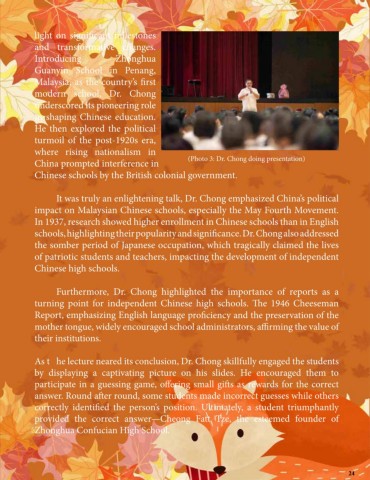
            China prompted interference in                     (Photo 3: Dr. Chong doing presentation)

            Chinese schools by the British colonial government.


                    It was truly an enlightening talk, Dr. Chong emphasized China’s political
            impact on Malaysian Chinese schools, especially the May Fourth Movement.
            In 1937, research showed higher enrollment in Chinese schools than in English

            schools, highlighting their popularity and significance. Dr. Chong also addressed
            the somber period of Japanese occupation, which tragically claimed the lives

            of patriotic students and teachers, impacting the development of independent
            Chinese high schools.


                    Furthermore, Dr. Chong highlighted the importance of reports as a
            turning point for independent Chinese high schools. The 1946 Cheeseman

            Report, emphasizing English language proficiency and the preservation of the
            mother tongue, widely encouraged school administrators, affirming the value of
            their institutions.


            As t  he lecture neared its conclusion, Dr. Chong skillfully engaged the students

            by displaying a captivating picture on his slides. He encouraged them to
            participate in a guessing game, offering small gifts as rewards for the correct
            answer. Round after round, some students made incorrect guesses while others

            correctly identified the person’s position. Ultimately, a student triumphantly
            provided the correct answer—Cheong Fatt Tze, the esteemed founder of
            Zhonghua Confucian High School.


                                                                                                                    24

