


Page 47 - 2021 English Magazine - Final
P. 47
The  Korean boy-group BTS has been dominating music charts

 worldwide. They have won Top Social Artist on the Billboard
 Music Awards for five consecutive years through landslide vic-
 tories, defeating several world-renowned Western artists. So
 what is K-pop and how did it obtain such explosive popularity
 Rise  among people outside Asia?


 The rise of Korean Culture, also known as the Hallyu Wave, is
 the international rise of K-pop and K-culture. It is attributed to
 Of  lease back in 2012, followed by BTS, BLACKPINK and hundreds   The Dark Side of
 PSY’s Gangnam Style that swept the world following its re-

 of other K-pop groups. The then-rising popularity of K-pop al-
 lowed it to become central to lots of other profitable fields like
 the beauty industry. Many fans of different races and nation-  K-pop is undoubtedly the biggest part of K-culture, now
 alities started to learn Korean, eat Korean food, and travel to   being a multibillion-dollar industry, and is central to many  K-pop
 Korea to immerse themselves in the culture.
         other industries such as fashion and beauty. However, con-
         quering the world comes with a hefty price.
 Before we dive into how K-pop became the global phenomenon we see today, who is it that
 paved the way for K-pop to achieve such global popularity today?
         1. Korean Beauty Standards
         The most prominent side-effect of the rise of K-culture is the popularisation of even higher and
 Many will think that BTS is the pioneer of the global recognition of K-Pop, however, others   more rigid beauty standards. “Per Korean beauty standards, a slim figure, small face and V-shaped
 think that the true leaders of K-pop are the early generation K-pop artists. Groups such as Su-  jawline, pale skin, double eyelids, flawless skin and larger eyes are often considered a must to be
 per Junior, Big Bang and Wonder Girls were the first to receive global attention with hit songs   beautiful,” according to fashion blog Madame Blue. This impossible standard fuels young teen-
 like Fantastic Baby, Sorry Sorry, and Nobody. They were followed by the third and fourth gen-  agers to pursue beauty by using appearance-enhancing tools such as makeup and Photoshop.
 eration of K-pop idols, such as EXO with Love Shot, TWICE with TT, NCT with Make A Wish,
 Stray Kids with God’s Menu and ITZY with Dalla Dalla.
         Many have even taken a step further to be beautiful by utilizing extreme measures such as cos-
         metic  surgery and  intense dieting.  It is  common  for  enter-
 Other than K-pop, K-dramas are also a major driver to promote the Korean culture. K-drama   tainment companies to force their artists into harsh diets to
 and K-movie genres can range from sweet rom-coms to mafia movies to horror series. Dra-  achieve that perfect Barbie body, leading to body dysmorphia
 mas and movies such as Train to Busan, Vincenzo and Penthouse have gained worldwide   and eating disorders. One case in particular has sparked much
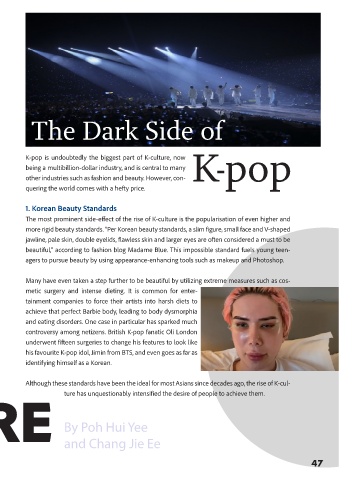
 popularity despite being in an uncommon language. Many shows such as Parasite have won   controversy among netizens. British K-pop fanatic Oli London
 major film   awards, proving Eastern productions to be on par with Hollywood   underwent fifteen surgeries to change his features to look like

 films.   Korean dramas nowadays emerge as a creative outlet to depict Ko-  his favourite K-pop idol, Jimin from BTS, and even goes as far as
 rea’s society and promote its exotic landmarks. Through these me-  identifying himself as a Korean.
 dia, people around the world have gotten the chance to explore and
 fall in love with Korean culture.
         Although these standards have been the ideal for most Asians since decades ago, the rise of K-cul-
                      ture has unquestionably intensified the desire of people to achieve them.


                      By Poh Hui Yee

                      and Chang Jie Ee


 46                                                                                                   47

